
Blog & News
Swing Gate vs Sliding Gate: Which Is Better for Bay Area Homes
jay jay
Aug 27, 2026
Article, Uncategorized
You’ve decided to add an automatic gate to your driveway — now the next question stops a lot of homeowners cold: swing gate vs sliding gate, which is better for Bay Area homes? The answer isn’t universal. It depends on your driveway slope, the width of your entrance, your budget, and how much maintenance you’re actually willing to do. Here’s the honest comparison I give every customer before we touch a single post-hole.
The Honest DIY vs. Pro Trade-Off Matrix for Gate Installation
Before we compare gate types, let’s talk about who should be installing either one. I get asked regularly whether a capable DIYer can handle this project.
Cost matrix: A mid-grade swing gate kit runs $800–$1,800 in materials. A sliding gate kit is $1,200–$2,500. Either way, professional labor adds $1,500–$3,500 depending on site prep. If you’re budget-limited and the site is simple — flat ground, no existing concrete to break up, clear post locations — DIY can save real money on swing gates specifically.
Risk matrix: Sliding gates require a buried track or a cantilever system with precise engineering. Mis-set a track by half an inch and the gate binds or derails inside six months. Swing gates are more forgiving in that sense, but hitting the wrong underground utilities during post installation is a universal risk. We’ve been called out to fix DIY jobs where someone hit irrigation lines or conduit — the “savings” evaporated fast.
Time matrix: A two-post swing gate install by a pro crew takes 4–8 hours. A sliding gate with concrete track-base work takes 1–2 full days. For a first-time DIYer, double those numbers and budget for at least one problem-solving trip to the hardware store.
Decision rules:
- Flat lot, single-panel gate under 12 feet, you’re comfortable with concrete work → DIY swing gate is reasonable.
- Any slope over 5 degrees, driveway wider than 16 feet, or you want a cantilever slide → hire a professional.
- Automated opener wiring in California requires permit compliance either way — factor that in.
How Swing Gates Work — and Where They Thrive
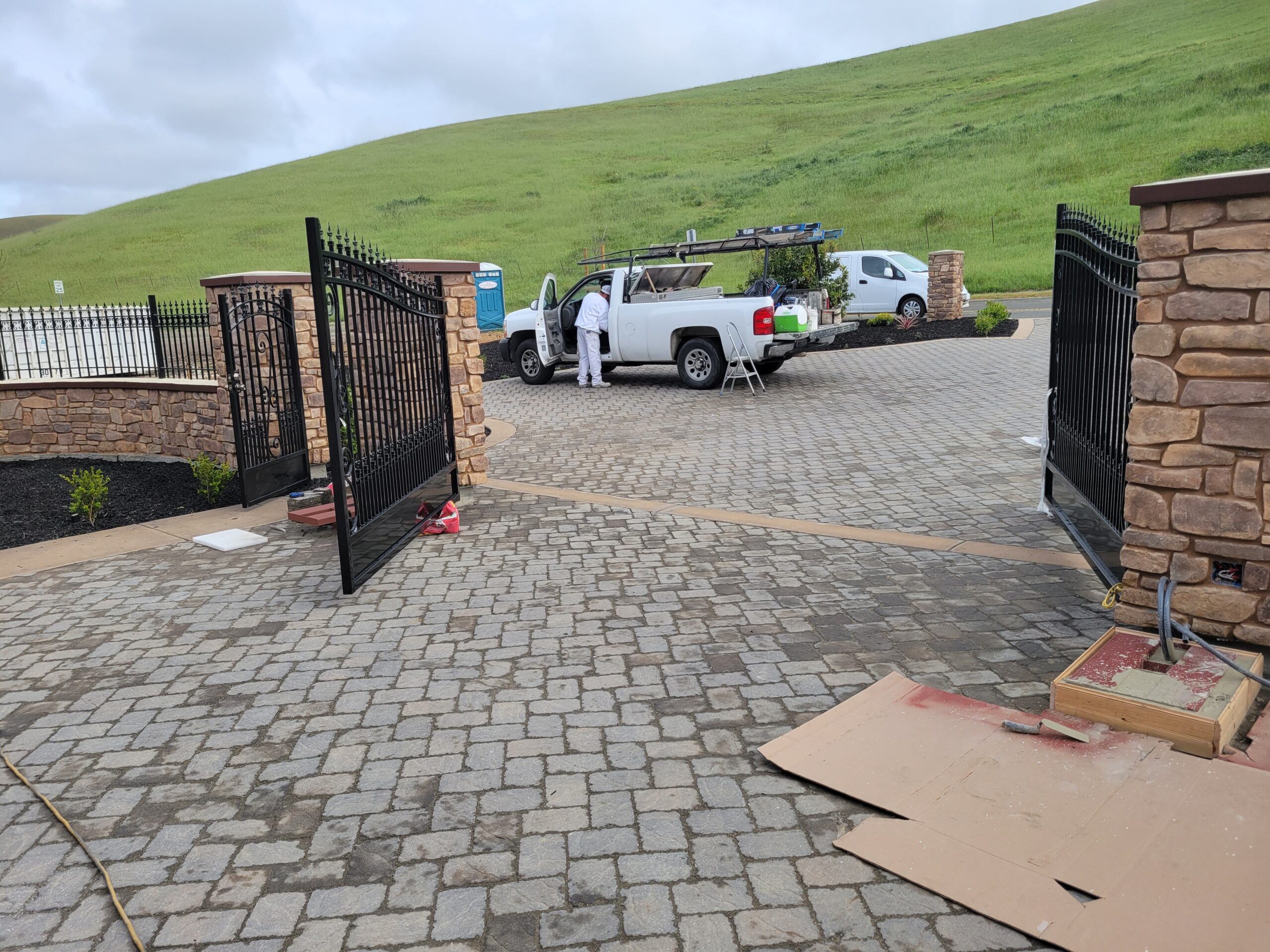
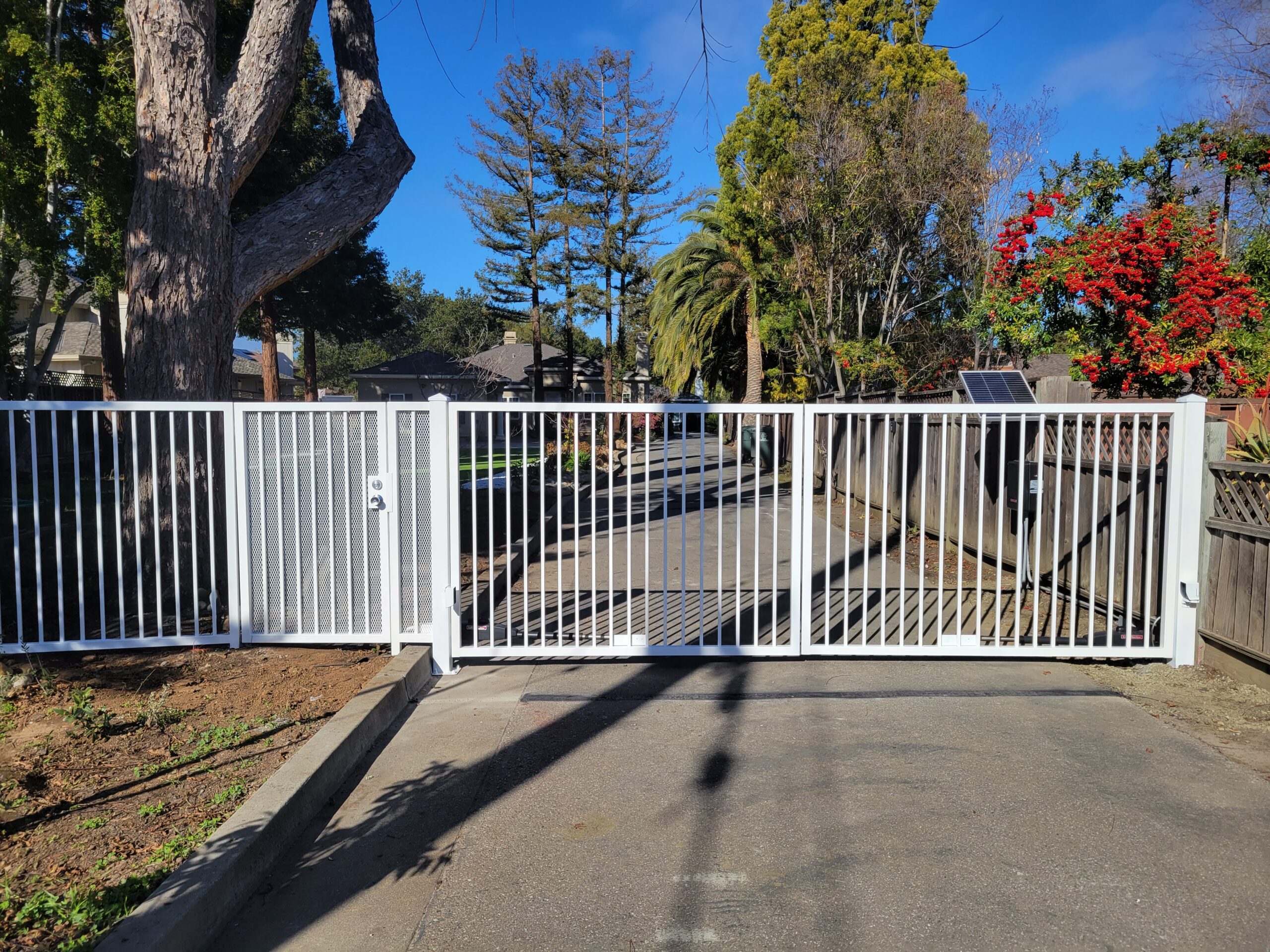
A swing gate pivots on two posts, opening inward or outward like a door. You can run a single panel (one leaf) up to about 16 feet, or a dual-leaf pair for wider entries. The automation is a linear actuator or underground ram — both are reliable, serviceable, and parts are widely available.
Where swing gates are the right call:
- Flat or near-flat driveways. Swing gates need a clear arc to open. On a level lot, a 14-foot dual-leaf gate swings open in about 5 seconds with a quality actuator.
- Shorter driveways. If you’re pulling up and stopping within 10–12 feet of the gate, an outward-swinging gate needs room in the street — check your local setback rules. Inward swing solves this if you have the depth.
- Tighter budgets. Posts, hinges, and actuators are simpler and less expensive than the hardware required for a heavy sliding gate system.
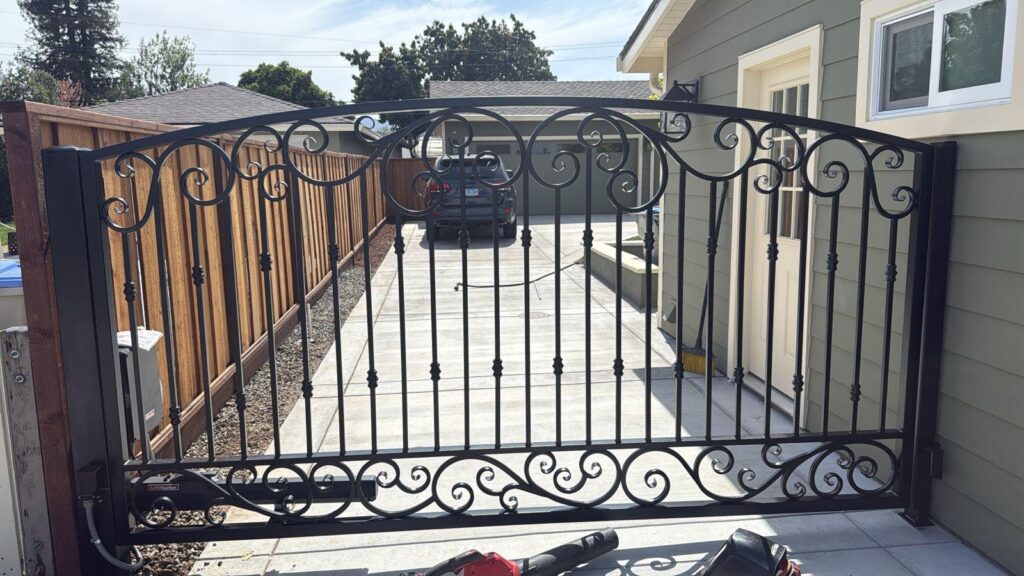
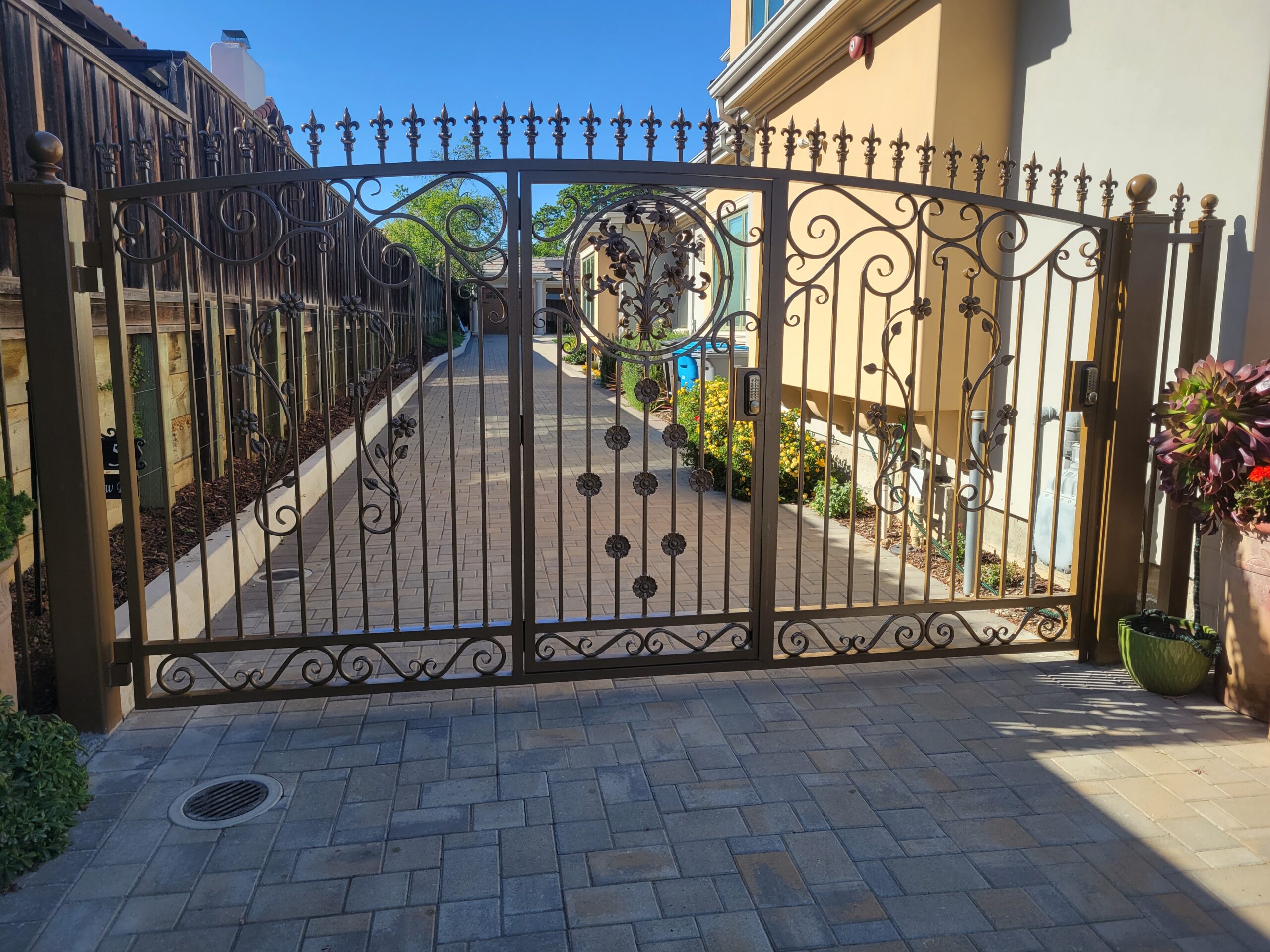
- Classic aesthetics. Wrought iron and ornamental steel swing gates look proportionally right on most residential Santa Clara County lots. Check our gallery of completed projects to see how they photograph against typical Bay Area architecture.
Where swing gates struggle: Any driveway with a significant incline. If your driveway slopes upward from the street, an inward-swinging gate drags on the pavement as the ground rises. You can arc the gate panels to accommodate a modest slope, but beyond about 8–10 degrees the geometry stops working and you’re looking at a gap at the bottom of the arc — a security and aesthetics problem.
How Sliding Gates Work — and Where They Shine
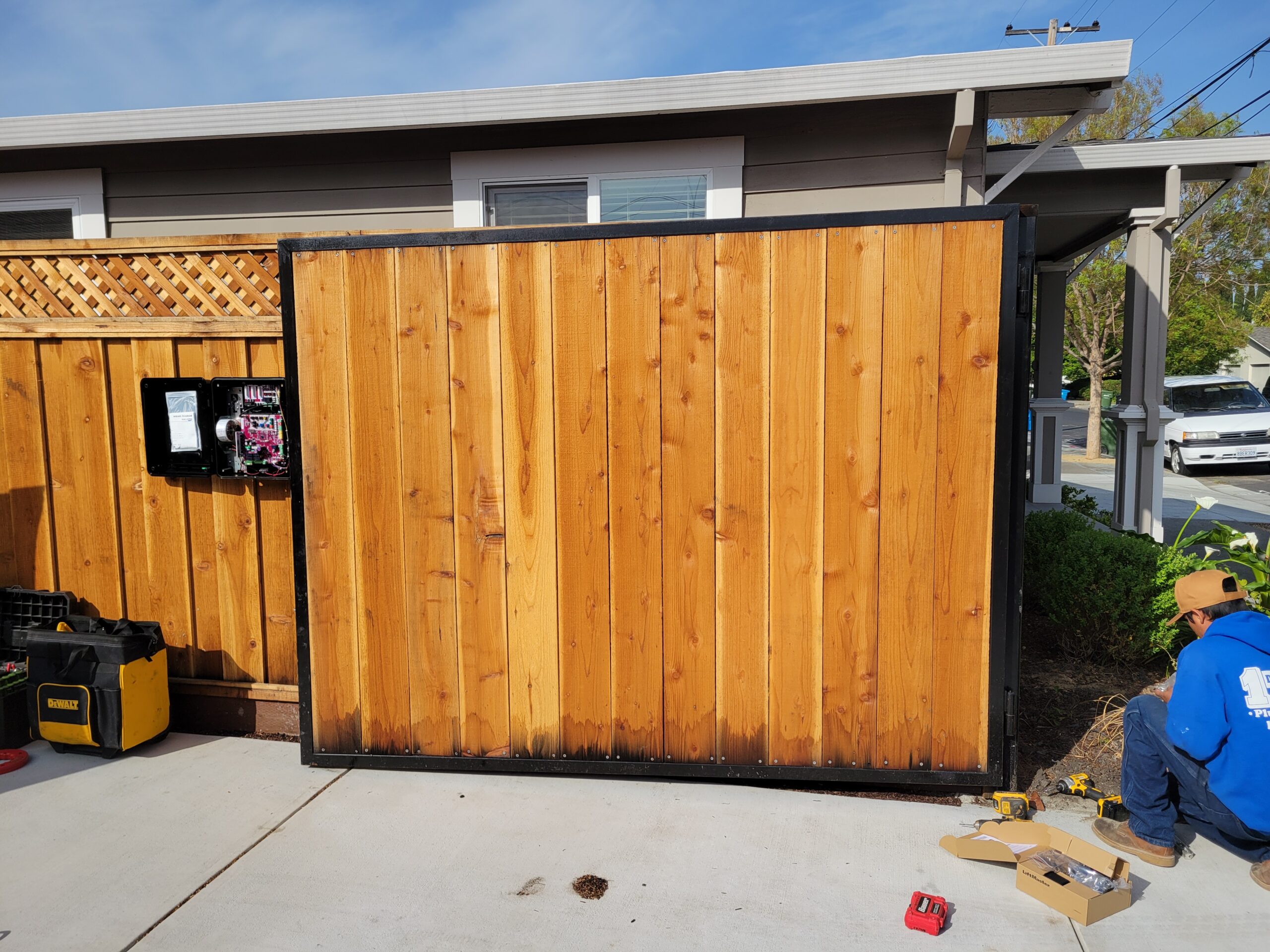
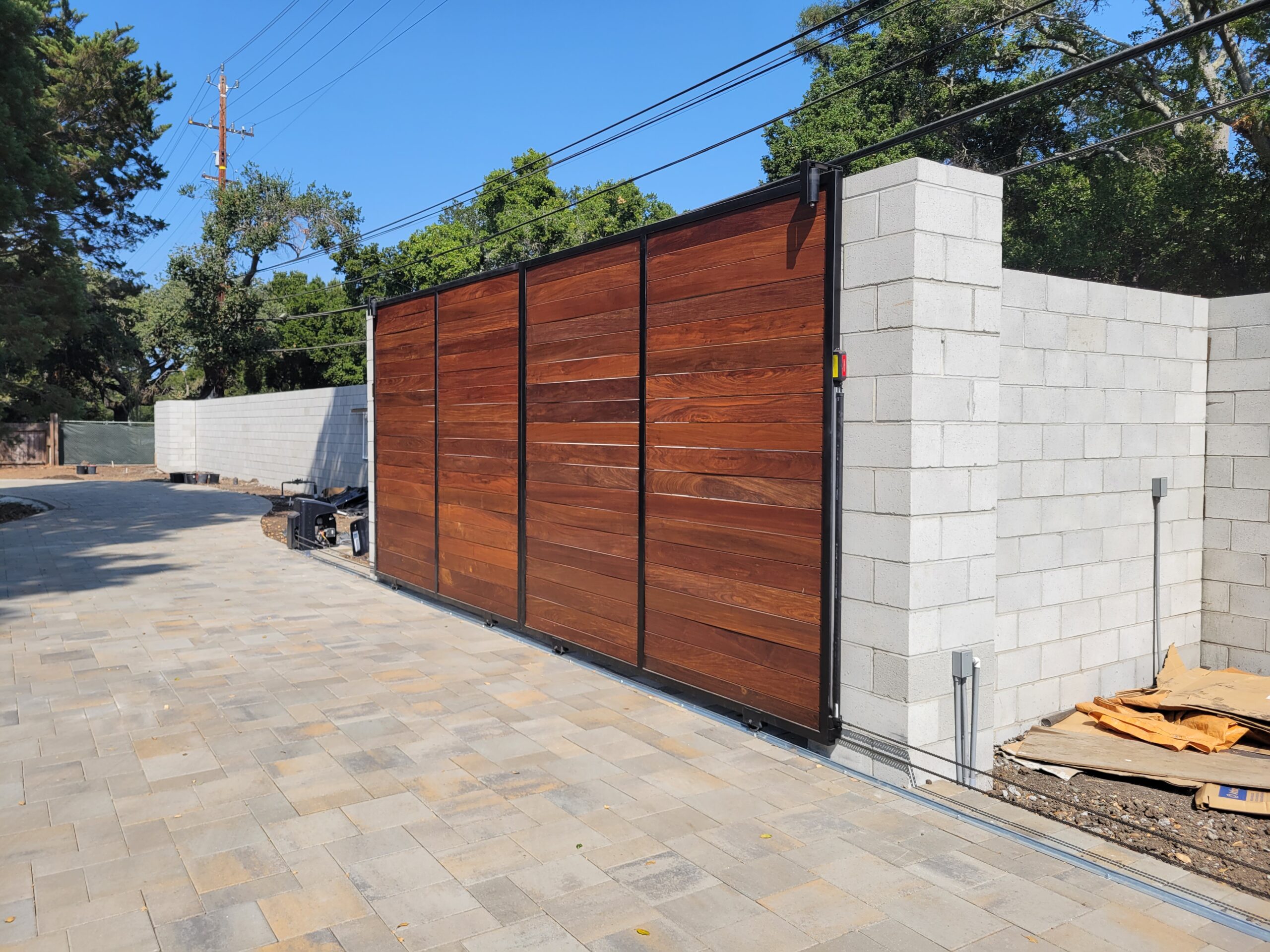
A sliding gate rolls laterally along a track (or hangs from a cantilever beam) parallel to your fence line. There’s no pivot arc, which removes the slope constraint entirely. The automation is a rack-and-pinion motor — more torque for heavy gates, quieter operation in many cases, and very low maintenance on the drive mechanism itself.
Where sliding gates are the right call:
- Sloped driveways. This is the most common reason we spec a slider in the Bay Area. Hillside neighborhoods in Los Gatos, Cambrian Park, and similar areas have driveways that a swing gate simply can’t handle cleanly. For properties needing gate installation in Los Gatos, sliders come up in probably 60% of site assessments.
- Narrow street frontage. No arc means no intrusion into the road or neighboring property. If your setback is tight, a slider keeps everything on your side of the property line.
- Wide commercial-style entries. Spans over 20 feet are almost always sliding gate territory. The structural load on swing-gate hinges and posts at that width creates long-term sag issues — we’ve replaced a lot of bent hinge posts on undersized swing-gate installations.
- High-traffic driveways. Rack-and-pinion motors handle repeated cycles better than linear actuators under heavy daily use.
Where sliding gates struggle: They need a clear run of fence line at least 1.5× the gate width to park the panel when open. A 16-foot gate needs roughly 24 feet of unobstructed fence to slide into. If your property has a perpendicular wall, a corner post, or a utility box in that run, a cantilever system (no ground track) solves it — but costs more.
Slope, Space, and Soil: The Bay Area Factors That Tip the Decision
The Bay Area throws a specific combination of variables at gate installers that you won’t find in, say, flat Central Valley towns.
Slope: As mentioned, anything above 5–8 degrees of incline makes swing gates problematic without custom fabrication. Bay Area hillside neighborhoods regularly hit 15–20 degrees. Sliding gates handle this natively.
Clay soil expansion: Expansive clay soils — common throughout Santa Clara County — shift seasonally. Post footings for swing gates need to go deeper (typically 36–42 inches with a bell-bottom footing) to resist lateral heave on the hinge posts. Sliding gate tracks embedded in a concrete pad are less susceptible because the load is distributed differently.
Seismic movement: Minor settlement from seismic activity can throw a swing gate’s alignment off over years. Sliding gates can tolerate minor post movement because the track geometry has more tolerance. We’ve seen this difference play out on older properties after 5.0+ magnitude events — swing gates needed re-alignment, sliders kept running.
Limited turnaround space: Many Bay Area lots don’t have the 20-foot vehicle approach depth needed for an outward-swinging gate. Inward swing works but requires that depth on the inside. Sliders sidestep this entirely.
For a deeper look at how these site factors shape our recommendations, browse our project work for gate installation in Campbell — that service area covers a range of lot types from flat suburban driveways to hillside parcels.
Looking for Affordable Garage & Gate Repairs?
We offer quality service at competitive rates. Call (650) 912-1200 today to schedule your repair.
Cost Comparison: Swing Gate vs Sliding Gate Installed
Here’s what real installed costs look like in the Bay Area right now. These are ranges we quote, not hypotheticals.
Swing gate (automated, dual-leaf, ornamental steel):
- Materials + hardware: $2,000–$4,500
- Labor + concrete footings: $1,500–$2,500
- Total: $3,500–$7,000
Sliding gate (automated, single panel, steel):
- Materials + hardware: $2,800–$6,000
- Labor + concrete track base or cantilever: $2,000–$4,000
- Total: $4,800–$10,000
The gap narrows significantly on a hillside lot where a swing gate would require heavy custom fabrication to work at all — at that point the slider’s premium disappears.
Access control (keypads, intercoms, phone-app integrations) adds $400–$1,500 on either type. If you’re planning a full driveway gate installation Bay Area project with access control, budget for that from the start rather than retrofitting later — it’s cheaper to run conduit during the initial concrete work.

Which Type Holds Up Better Over Time in Northern California Weather
Neither type is dramatically more durable than the other if it’s properly powder-coated and the motor is properly housed. But they fail differently.
Swing gate failure modes: Hinge wear (fixable, inexpensive), actuator seal failure from UV exposure (replace every 8–12 years on average), and post lean from soil movement (the most expensive fix if it progresses).
Sliding gate failure modes: Track debris accumulation (clean it quarterly and this is a non-issue), nylon guide wheel wear (cheap replaceable part), and rack corrosion if the track isn’t sealed after installation.
In my experience, sliding gate motors tend to last longer in high-cycle residential applications because rack-and-pinion systems distribute load more evenly than the lever-arm stress on a swing actuator. On a gate opening 20+ times per day, that difference shows up in service life.



Frequently Asked Questions
Can I convert a swing gate to a sliding gate later?
Technically yes, but it's essentially a new installation — new posts, new concrete work, new motor system. Don't spec a swing gate as a "starter" with plans to convert. Choose the right type now.
How much slope is too much for a swing gate?
We generally call 8 degrees the practical limit for a standard swing gate without custom arc fabrication. Beyond that, the gap at the base of the arc becomes a real problem — both aesthetically and for containing pets.
Do sliding gates need more maintenance than swing gates?
The track on a ground-rolling slider needs quarterly clearing of leaves, gravel, and debris, especially here in the Bay Area where oak leaves accumulate. Cantilever sliders skip that, at higher upfront cost. Swing gate hinges need annual lubrication. Neither is particularly burdensome if you stay on schedule.
Which type is harder for intruders to force open?
A properly installed slider with a deadbolt latch is marginally harder to force because there's no leverage point for a push attack. However, the gate material and post embedment depth matter far more than the gate type for overall security.
Which type works better with a phone-app gate opener?
Either type pairs with modern smart openers equally well. The opener (LiftMaster, FAAC, DoorKing, etc.) is selected based on gate weight and cycle count, not the swing vs. slide mechanism.
Still on the fence? The single fastest way to get clarity is a 20-minute site assessment — we look at your slope, your fence run, your driveway depth, and your budget, and give you a straight recommendation. RNA Automatic Gates has been installing and servicing automated gates across Santa Clara and the broader Bay Area for over a decade. Call us or fill out our contact form to schedule your free on-site evaluation, and we’ll have a clear answer for your specific property — no guesswork, no upsell pressure.